Justice for Nid! Hunt sabs in protest at the races

Standard

In August last year, during a ‘cubbing’ meet held by the Blackmore & Sparkford Vale Hunt, their huntsman Mark Doggrell seriously injured a female hunt saboteur by running her over with his horse. Nid, as she is known in the sabbing community, was left with seven broken ribs, a collapsed lung and a damaged shoulder.

The incident was filmed by the sabs, and Doggrell arrested and charged. Both the ‘sabs’ and the police felt they had a good case. The Crown Prosecution Service thought otherwise. Last month they refused to prosecute on ‘insufficient evidence’. The Hunt Saboteur Association immediately made the video public. People were outraged at what they saw – the brutality of the attack, and the fact that Doggrell rode on without a glance over his shoulder at the unconscious body on the ground.

A petition circulated, demanding the CPS reconsider. Nid herself wrote to the CPS, asking them to review the case – which they are now doing. What else can they do, when people have seen for themselves what happened? The sabs and their many supporters are keeping up the pressure. On Sunday March 8 they held a peaceful protest at the big money-raising event of the year for the Hunt – the annual point-to-point race meeting.

In their wish to see justice for Nid, sabs had come from far and wide, the assault on her by Doggrell having stirred up huge anger among anti-hunting people. Hunting has often been seen, by those who support it, as a ‘class issue’ on the part of those who don’t – townies against the countryman. But what kind of ‘class’ do the hunt followers belong to; for it is they who are mostly responsible for the violence (those on the horses are more notable for their arrogance than hands-on thuggery).

They follow the hunt on their quad bikes, racing across fields and farmers’ crops and, where horses can jump the hedges, the followers pull gates off hinges and tear down fences to gain access for their bikes. They are the thugs who take pleasure in beating up anti-hunt people and, as happened at one recent meet, trashing a sab Land Rover and its equipment, before being pursued by the police helicopter.

And they take children with them. Speaking to a sab the day after the protest, I was told how upsetting it is to see the terror-stricken faces of the children as the quad bikes speed, bump and skid through the mud. How many unreported accidents are there, and what do they learn, these kids? That life is brutal and full of fear, and that the only way to beat the fear is to bully and threaten others.

The incident of the trashed Land Rover started with a man leaping off his quad bike, going to the Land Rover, breaking the driver’s window by hitting it with his elbow before punching the driver in the face. Then he was helped by other hunt followers joining in the attack. And he had, as a passenger on the back of his quad bike, and sitting there watching all this violence, a 7-8 year-old child.

The sabs had generously been given a parking area just outside the racecourse. Hunt security men tried to block them from entering this site until the police intervened. But – every car carrying protestors was filmed by the pro-hunt side. This is common practice (it happened during the badger culls too), and many sabs have been targeted at their homes, traced by their vehicle numbers.

With hundreds of vehicles full of race-goers expected and a single track between fields the only route to the course, some protestors lined the track with their placards, while many of the sabs stood across it, blocking the long queues of cars and horse boxes. As the police were allowing this, drivers had to be patient. The pro-hunt lads were not. One protester had his banner bashed aside with a stick. The same stick was then used on another (female) protestor’s legs.

There was a little violence, and one female sab was temporarily arrested while trying to prevent more cars from entering the racecourse. She was bodily thrown down into the mud several times by Hunt security men but kept getting up and trying again. It was perhaps not the best thing to do at what was meant to be a peaceful protest, but she was shaking with both fear and anger, and the anger kept her going.

It was clear the police, who succeeded in keeping the two sides apart, thought any trouble was going to come from the hunt followers. Any orders seemed to be directed at them, rather than the sabs.

One hunt follower, asked if he had seen the film, implied it had been Photoshopped, while some were ignorant of what the film showed. Yet another, escorting two protestors onto the course so they could buy some coffee (the Hunt apparently thought they would upset the horses), felt the sabs shouldn’t be asking for Mark Doggrell to be sacked because “he’s a good family man.” Such as his father, who has been banned from riding with the B&SV Hunt because of his behaviour.

The heavy brigade hung around until the sabs had left – all but two women and myself talking to a police officer. Then over 15 of them crowded round us, pressing closer and closer in a tight circle – until the very nice man in charge of arranging the security for the Hunt intervened and moved them on. But it was disturbing to see that several of them were in their very early teens, trying to emulate their elders and seeking looks of approval from them. Presumably they were learning how to grow up into ‘good family men’ like Mark Doggrell. So brave they are, these bully boys who kill foxes.

11/03/15 © Lesley Docksey

(First published by the Morning Star)

New Badger Watch Scheme launches in Dorset and beyond…

Standard

DBBW Badger watch

A network of dedicated wildlife lovers have officially launched a ‘Badger Watch’ scheme to detect and deter wildlife crime against badgers.

Badger setts across the county of Dorset will be regularly checked for interference during daytime walks, and at night a covert watch will be kept from a distance using sophisticated night-vision equipment.

The groups will work within the law to assist the police to prevent wildlife crime and to help the police to prevent and prosecute those who harm Dorset’s wild animals. Volunteers drawn from members of Dorset for Badger and Bovine Welfare will provide intelligence to local Wildlife Crime Officers in a similar way to that of the Neighbourhood Watch scheme.

Badgers are fully protected in the UK by the Protection of Badgers Act, 1992, and the Wildlife and Countryside Act, 1981. The Protection of Badgers Act 1992 consolidates past badger legislation and, in addition to protecting the badger itself from being killed, persecuted or trapped, makes it an offence to damage, destroy or obstruct badger setts.

Since the government’s unscientific and ill thought out badger cull trials, incidents of persecution against badgers and other wildlife, especially here in Dorset, has been on the increase and Badger Watch aims to counteract this.

Spokesperson Chris Kemp says;

“The Badger Watch scheme aims to prevent those criminals who seek to harm our wildlife from escaping justice. We have a network of experienced volunteers, veterans of the protest against the badger cull, ready to assist police in stamping out this vile activity. Our message to those who might consider engaging in wildlife crime is to think carefully, you may be being watched covertly and the police arriving may be the first you know about it!”

Lots of ‘Badger Watch Area’ stickers have been appearing all over Dorset already and even parts of Somerset. If you see one please send us a photo!

The Badger Watch sticker uses the main graphic from our Dorset for Badger and Bovine Welfare logo designed by local Graphic Designer Stu Jones and has even featured in the V&A exhibition of ‘Disobedient Objects’ – art and design produced by grassroots social movements.

Get Involved

Anyone wishing to know more or volunteer to help, please contact Dorset for Badger and Bovine Welfare (we are allied with Brian May’s Team Badger and the South West Alliance for Badgers).

If you’d like some of these stickers for your area please email dorsetbbw@gmail.com and we will send you the artwork and printing details or may be able to arrange to post some to you or you can collect from us. (Please do not stick them on the front of road or street signs, or on private property without permission).

Thank you to everyone who’s already keeping an eye on their local setts and reporting any criminal activity to their Wildlife Crime Officer.

If you see a wildlife crime in action dial 999, if it has already happened dial 101.
This website has a handy guide to recognising crime, recording and reporting: http://birdersagainst.org/badgers
The RSPCA helpline is 0300 1234 999.

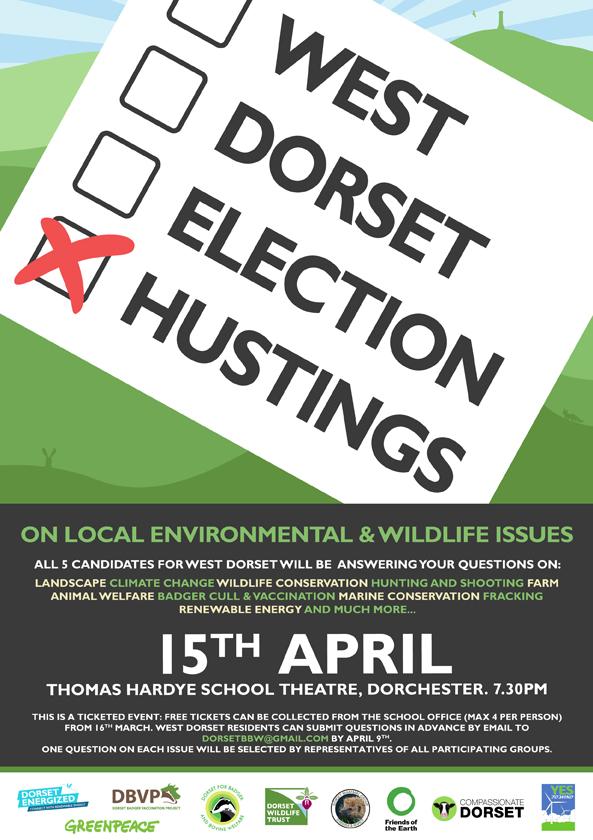
Dorset for Badger and Bovine Welfare support West Dorset Election Hustings on 15th April 2015

Standard

west-dorset-hustings

Dorset for Badger and Bovine Welfare are one of a number of local organisations taking part in the West Dorset Election Hustings for local Environmental and Wildlife issues.

All 5 candidates for West Dorset will be answering your questions on:

  • Landscape
  • Climate Change
  • Wildlife Conservation
  • Hunting and Shooting
  • Farm Animal Welfare
  • Badger Cull and Vaccination
  • Marine Conservation
  • Fracking
  • Renewable Energy
  • and more…

Tickets will be available from Thomas Hardye School in Dorchester from Monday 16th March (max. 4 per person). Tickets must be collected from the school, they cannot mail them. N.B. the school will be closed for 2 weeks over Easter from 28th March to 12th April.

Tickets are FREE but donations will be welcome at the end of the event for the Dorset Badger Vaccination Project and Hardye’s students’ environmental projects.

Please share this post widely across the West Dorset area.

You can download a PDF of the poster here >>

Hunting ban letter in Dorset press

Standard

One of our supporters had a great letter published in our local newspaper earlier this week which has had a great response on social media, so we wanted to share here…

Subject: Hunting ban

In an extraordinarily patronising speech yesterday, David Cameron referred to a “rural way of life which a born and bred Londoner might struggle to understand “.

Well, excuse me while I put down my pitchfork and remove the piece of straw from the corner of my mouth in order to articulate more clearly.

Most of us who manage to live outside the M25 are quite able to do so without feeling the need to kill foxes or to commit other wildlife crimes. The current legislation is badly enforced as it is, and needs strengthening not repealing.

Yet again, as with the hugely unpopular, ineffective and expensive cull of badgers, Cameron has shown that he is happy to ignore the views of the majority of wildlife-friendly people in this country in order to appease the wishes of a select few.

K. S., Dorset

West Dorset MP asked to ‘have a heart’ for badgers this Valentines

Standard

LETWIN STRODE ROOMS

Dorset for Badger and Bovine Welfare had a very successful Valentines Day Public Outreach Event in Weymouth on Saturday 14th February, where a few of our volunteers asked locals to ‘HAVE A HEART FOR BADGERS’, and were spreading the ‘vaccinate not exterminate’ message.

We handed out badger leaflets, packets of love hearts and ‘I Love Badgers’ stickers!

Most people were very supportive and several recounted stories of how they fed the badgers in their gardens on peanut butter sandwiches.

A heartfelt thanks to Animal Aid for their support with this event.

A small group from DBBW also presented West Dorset MP Oliver Letwin with a special Valentines’ Day Card, and we are very pleased to see it featured in the Dorset Echo this week.

The message inside read:

Badgers are beautiful in their striking black and white
Against their cull in Dorset all decent folk should fight
Vaccination is THE way to fight TB in cattle
Oliver, will you pledge to join us in our battle?

Oliver Letwin told us that he did think vaccination was the way forward if it works. And yet he has officially commented; “I believe we should use every effort we can to control this disease and while we don’t yet have an alternative we should try to get the culls to work.”

What about Wales Oliver, we ask? What about cattle movement measures, improved bio-security on farms, testing and developing an effective cattle vaccination?

We say, Oliver you’re not listening to the scientists – culling is cruel, costly and unpopular, but most of all it doesn’t work!

Please send your letters and comments to the Dorset Echo at letters@dorsetecho.co.uk or read the full article and comment online here.

No Justice for Hunt Saboteurs

Standard

War is being waged in the countryside, in the fields and along the quiet lanes, and nowhere is this more apparent than in the Dorset and Somerset ‘territory’ of the Blackmore & Sparkford Vale Hunt. On one side are the foxes and the hunt saboteurs; on the other the masters, the huntsman and hunt followers of various kinds.

The ‘sabs’, dedicated to protecting wildlife, are being targeted by people intent on ignoring the 2004 Hunting Act. The hunts believe the countryside belongs to them and they have the right to act as they please, regardless of law – a powerful lobby that seems to have a stranglehold on the police and the Crown Prosecution Service.

The sabs film everything, gathering evidence of hunting laws being broken by the hunts. And they film incidents of their vehicles being smashed, themselves being assaulted, badly beaten and in several cases hospitalised with their injuries. In the 1990s two sabs were killed yet no prosecutions followed. The situation hasn’t improved, as the lack of law demonstrates. And now the CPS has refused yet another case on ‘insufficient evidence’.

The ‘insufficient evidence’ consists of a film of a woman being deliberately galloped over by the BSV huntsman Mark Doggrell. Several other sabs witnessed the event. Having sent the woman flying, Doggrell galloped on without a backward glance. This happened during an evening cubbing meet in August near the Hunt’s kennels at Charlton Horethorne.

When contacted after the incident, the investigating officer said that, although he’d welcome additional evidence, he felt the police already had enough to prosecute. The additional evidence, from a farmer who needed to remain anonymous, was that the Hunt masters met with Doggrell that evening and decided on the statement he should give to the police.

During the meeting they reportedly said that they “couldn’t afford a hiccup this early in the season,” the implication being that they would have no one to take his place as huntsman, the man who looks after the hounds. Arrested and charged, he was soon seen back in the saddle.

Doggrell’s prepared statement said that the woman had deliberately jumped in front of his horse. The video clearly shows that she did not move from where she and her companion were standing with their backs to the oncoming horse.

The woman lost consciousness shortly after being struck. She had seven broken ribs, a punctured lung and ‘trauma’ to her shoulder. It was feared at the time that her spine had also been injured. An air ambulance attended the scene, partly because riders and horses blocked the normal ambulance from accessing the injured woman.

Mark Doggrell is a violent man. Last November he reportedly assaulted a young man at the local Hunt Ball, breaking his nose. Years ago while in his teens, after an argument with a young gamekeeper, he took an axe to the gamekeeper’s front door only, so local gossip had it, to be met on the other side of the broken-down door by the gamekeeper’s shotgun!

Since this incident the Dorset Hunt Sabs have been the target of ‘Anti-antis’, groups of violent masked men dressed to look like sabs and allegedly shipped in from other hunts. They appear at any BSV meet and attack the legitimate sabs, the most recent incident involving 30-40 of them. The BSV tells everyone that these thugs are the sabs, spreading the propaganda that the Hunt is squeaky-clean innocent and the sabs are criminals.

After the CPS decision the hunt sabs released the video to the press. According to the Sunday Times, “Michael Felton, senior master of the Blackmore and Sparkford Vale Hunt, said the incident occurred during a legally permitted drag hunt that did not involve any live foxes being chased.” Well sorry Mike, this was a ‘cubbing’ meet, and the Hunt was witnessed drawing a cover to flush out foxes. There is a deal of difference between drag hunting (following a pre-laid scent) and fox hunting. The BVS wouldn’t be seen dead engaged in drag hunting.

The Countryside Alliance, with strong links to the NFU and founded during the campaign against the Hunting Act, gives the impression that all ‘real’ country folk support hunting. Not true. Many farmers dislike the hunts but are afraid to ban hunting on their land because of the attacks they suffer from hunt followers. As one farmer said, “my life wouldn’t be worth living.”

The hunts have never stopped breaking the law, taking full packs out and killing foxes, assaulting and injuring sabs while apparently safe from prosecution. And the war against people trying to stop hunting has reached a new and more violent stage.

The situation is not helped by the CPS refusing to prosecute what appeared, from a police point of view, to be a clear case. How much ‘sufficient evidence’ is needed? And one has to ask: who owns the law? The hunts? The landowners? The Countryside Alliance? Certainly not the people fighting to get the law complied with, and who should be protected by the law, not simply left to recover, as best they can, from their injuries.

On the positive side, because of the infamous badger culls in which sabs have played a vitally important part in preventing the needless killing of badgers, membership of the Hunt Saboteur Association has soared. More and more people are bravely standing up to defend both the law and our wildlife.

10/02/15 © Lesley Docksey

Detective sergeant Dan Mason 2141 Tel: 01935 402156

Hounds Off launch new website to protect farmers, landowners and the public against wildlife crime

Standard

hounds-off-ipad-cc-blog

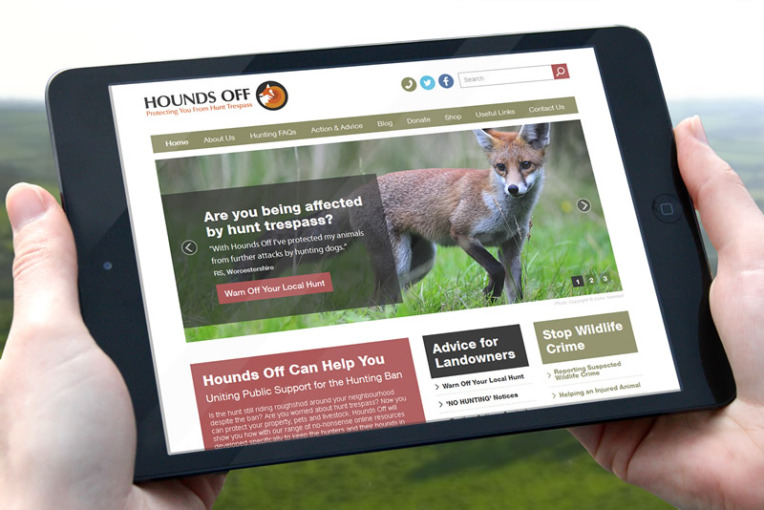
Hounds Off, a free online resource designed to help landowners, farmers and residents to protect their property and pets from hunt trespass, and to encourage the public to report suspected wildlife crime, has just rebranded and launched a fantastic new, easy-to-use website.

The new logo was designed by Dorset Illustrator / Designer Stu Jones, who is the talent behind our own Dorset for Badger and Bovine Welfare logo and the Dorset Badger Vaccination Project’s logo, and is a key member of local animal welfare group Compassionate Dorset.

Hunting most wild mammals with dogs for sport was banned in England and Wales in 2004, including fox, deer, hare, mink and also badgers, yet many hunts are continuing illegally and often cause ‘hunt havoc’ in the countryside.

As Hounds Off say on their website; “Most compassionate, decent, fair-minded folk in Britain disapprove of animal cruelty. Latest opinion polls found that 76% of the British public are against fox hunting being legalised, rising to 81% for deer hunting and 83% for hare coursing.”

With the threat of the badger cull, we have also realised just how loved our British badgers are too, and they are of course otherwise a protected species. Check out some badgery facts on the new website at: www.houndsoff.co.uk/hunting-faqs/badgers-other-mammals.

There are also lots of gorgeous foxy clothing, prints, cards and accessories we are sure you will love, if you haven’t seen them already, on the  Hounds Off shop at: www.houndsoff.co.uk/shop (and we hear on the grapevine that car window stickers will be available very soon too!).

The new website has now had over 3,000 shares on Facebook alone in just 2 weeks of relaunching so please do share the site yourselves to spread the word of this valuable resource.

Read more at the new website at: www.houndsoff.co.uk/blog and view the website at www.houndsoff.co.uk.

Yet Another Debate on the English Badger Culls

Standard

And here is another great recent article by Lesley Docksey

“A change of protocol half way through an experiment reveals such a limited understanding of the scientific method that I am tempted to speculate that the government no longer wants to know whether the pilots are effective or humane. They just want to cull badgers, regardless of whether the population or humaneness consequences can be assessed.” Prof. Tim Coulson, member of the ex-Independent Expert Panel

The scientifically useless, inhumane and very unpopular government policy of killing badgers, supposedly to help eradicate bovine TB in cattle, is still being pushed by the Department for the Environment, Food and Rural Affairs (Defra), with the National Farmers Union stepping on their heels.

How many more debates will be argued in Parliament, and how many more letters signed by scientists, vets and wildlife experts will be sent to Defra, to the Environment Secretary, to the Prime Minister and the national press before the government finally yields to science and lets the badger cull go?

The second year of the culls ended with a bit of an embarrassing whimper. We can at least be grateful that Natural England was wise enough not to issue extended licences this year, but the leaked figures showed another failure. Before they even began the cull, the targets had already demonstrated that the process was a failure anyway. Had Defra pulled the figures out of a hat they wouldn’t have been any less realistic.

Defra’s only response to the leak was: “The figures still need to be independently audited. The humaneness of the culls will also be reviewed.” Given the extremely poor records provided to the AHVLA and the Independent Expert Panel by the contractors last year, I doubt the figures provided this year will be any more accurate.

As Defra got rid of the IEP, who are the ‘independent auditors’ they are proposing to use? Will the public ever know, let alone be able to judge their independence? Could it be NFU executives or a panel of grouse moor owners? A single auditor, perhaps? Certainly it would be difficult to get badger and wildlife experts to take part – they’ve mostly all migrated to the anti-cull camp. Nor is any date set for when Defra’s results will be made public.

Which is why there was yet another debate among Members of Parliament in the Westminster Hall on November 4, this time to assess the culls. Though there were fewer MPs present than in previous debates, those speaking against the culls have become much more informed on the issues. Sadly the pro-cull side is still using the same arguments and justifications, dealing with the reservoirs in wildlife and all the rest. They must really believe that if you repeat something often enough it will turn into the truth. A vain hope.

On the day of the debate the Journal of Animal Ecology offered to provide “a transparent and independent review of the available evidence”, a generous suggestion which was, of course, turned down by the Farming Minister George Eustice.

The debate was led by that stalwart badger defender Chris Williams. In his opening remarks he made his opinion clear:

“…on badger culls scientific, parliamentary and public opinion are at one, yet the Government are completely disregarding all those areas of clear opposition to their direction of travel on the issue… the Government and all of us present are elected by the British people and not by any single issue group. Ministers seem to be behaving as if they were the parliamentary wing of the National Farmers Union. The NFU, however, does not even represent the vast majority of the farming industry…”

Which greatly upset Neil Parrish, very much an NFU farmer from the West Country. Anne Main, who had led a previous badger cull debate, later responded to Bill Wiggin (Conservative, N. Herefordshire) , “I certainly shall give way to the branch of the NFU that is my hon. Friend.” Clearly the anti-cull MPs had identified the NFU’s influence on Defra as being a major part of the problem, and were giving it a good, if polite, kicking.

But the real heart of the debate was, and always is, that badgers are to blame for the spread of TB in cattle. We are asked to accept that vaccinating diseased badgers will not cure them of TB. Whoever, except pro-cull MPs, Ministers and the NFU, have ever suggested such a scientific silliness? And, however much they talk about the Welsh badger vaccination project, they will NOT talk about the real reasons behind the reduction of bTB in Wales.

As an example, Simon Hart (Conservative, Carmarthen West and South Pembrokeshire) said:

“The reality is that the Labour Government in Wales fully recognise that they cannot measure the impact of vaccination yet, and what reduction there is of bovine TB in Wales is just the same outside the vaccination area as it is inside…”

Might it be that that a policy covering the whole of Wales is working? But no. Back to the badgers. Geoffrey Clifton-Brown (Conservative, The Cotswolds) agreed.

“Although TB has been reduced in Wales, the current vaccination programme is only being conducted in 1% of the country and it is only in its second year. It is therefore difficult to see how the Welsh experiment – as he said, the Labour party in Wales do not think it is working – has led to a 25% reduction across the whole of Wales, where other factors must be at play.”

Actually, the Welsh government do not and have not ascribed the reduction in TB to badger vaccination. Other factors? Would they even look at them? Annual testing of cattle, strict movement controls, bio-security measures – oh no no! Don’t even go there. Anne McIntosh weighed in with how expensive badger vaccination is: “In Wales, the cost of an injectable vaccine for badgers was estimated at about £662 per badger in 2012.”

However in 2014, the first year of operating the Dorset Badger Vaccination Project, the cost was something over £300 per badger, and now that equipment such as cage traps have been bought, they are looking to halve that cost next year. All this has been done on donated funding. The farmers have not had to pay. But in Somerset and Gloucester farmers are funding the culls, on top of all their other financial problems. And the true costs of last year’s culling were leaked.   As the Badger Trust reported on November 14:

‘The front page of Daily Telegraph today says that each badger killed during last year’s cull cost £3000, with 1,879 badgers being killed at the cost of £6.3 million. However, a glaring omission from the figures is the £3.5m cost of policing the cull. When this is added on, the cost per badger is actually £5,200.’

But what would George Eustice have to say about Wales and its reduction in bTB?

“My hon. Friend Geoffrey Clifton-Brown and others highlighted the situation in Wales and the limitations of vaccination. He is right that it is wrong to read too many conclusions into the fall in incidences of the disease in Wales.”

Would he mention anything about Wales other than badger vaccination? Never. But as Farming Minister, he must have known what the latest bTB statistics were showing. Just two days later a notable list of 26 scientists and vets wrote to David Cameron, asking him to listen to science and abandon the culls.

“If we are to control bTB in England, as Wales is showing it is able to do, we consider that a fundamental change in emphasis and direction is needed. The time, effort and resources directed at the badger cull should be re-directed into:

  1. a TB Health Check for England to establish the true extent and distribution of the disease in our cattle herds;
  2. considerably more testing in the Low Risk Area with the implementation of nationwide annual testing and
  3. the introduction of mandatory pre-movement testing and risk-based trading across the whole country.

At the same time the livestock industry, NFU and farmers must be made aware that such cattle controls are essential if bTB control is to be achieved.”

And they kindly added an appendix that explained the latest statistics from Defra. For a pro-cull government, intent on keeping the NFU happy, they do not make comfortable reading. Nor do they support those NFU farmers who insist that bTB in the West is ‘out of control’.

(These figures are updated from the latest Defra statistics, released on November 12.)

In the West Region, which covers a far greater area than that covered by the Somerset and Gloucester culls, the number of cattle slaughtered due to bTB fell by 12% between 2012 and 2013, and the trend is continuing into this year; the 2014 January-to-August period showed a reduction of 14% compared to the same period last year.

In Wales there was a 15% reduction in new TB-affected herds and a 23% fall in cattle slaughtered during September 2013 – August 2014 compared to the same period a year before.

But in the East and North Regions, the cattle-slaughter rate increased by 10.2% and 9.09% respectively from 2012 to 2013, with the trend continuing to rise this year.

How can this be? It’s really very simple. The West Region has long been regarded as England’s bovine TB ‘hotspot”. As such, farmers have to put up with annual and pre-movement testing, as well as cattle movement restrictions with, initially, the greater levels of slaughter. Initially because, as infected cattle are found by increased testing and taken out of the herds, with each year fewer cattle can be infected. All of Wales has had such measures since 2009. In the East and North, however, there are many areas that have far less testing and cattle controls, and that opens the door to bTB.

Are you listening, Mr Cameron?

In the face of Defra’s own statistics, we don’t really need their ‘independent’ audit on this year’s culls. And surely we do not need any more debates, or letters to Ministers or emails to MPs. And we most certainly do not need any more senseless killing of the badgers. Farmers have to ask themselves – will they put up with the controls that result in healthy cattle or be put out of business by TB?

20/11/14 © Lesley Docksey

First published by Brian Mays’ Save Me www.save-me.org.uk

The English Badger Culls: the NFU’s Successful Failure

Standard

Here we share anther great article by Lesley Docksey...

The UK government’s highly unpopular ‘pilot’ badger culls have just come to the end of the second year of a four-year programme. Even without the independent oversight, monitoring and auditing by an Independent Expert Panel (IEP), discarded by the government after last year’s slating by the IEP, the culling has been as much of a failure as last year, despite the National Farmers Union (NFU) hailing it as a ‘success’.

But the NFU has been steering this policy of slaughtering our badgers for years. Ever since the first bovine TB-infected badger was found in 1971, to the surprise of animal scientists, farmers who dislike the controls and testing of cattle that can reduce the incidence of bTB have had something other than farming practices to blame.

Strict testing and bio-security controls were well on the way to eradicating bTB by the late 1960s, and complacency set in. A farming friend told me that he can remember farms with TB being required, among other things, to install double fencing between fields; he can also remember the very actions that had brought the disease under control becoming non-mandatory.

Once badgers came into the picture farmers started to cull them. To their annoyance in 1973 the badger was given some, but not enough, protected status. Even so, in 1975 ‘strategic culling operations’ were being carried out by gassing. This was banned in 1980 but the killing went on. Unfortunately, the incidence of TB in cattle was rising again.

No one mentioned the changes in farming practices; the intensification of cattle, particularly in dairy farming; the importing of continental breeds with no proven immunity to TB; increased cattle movements (another farming friend, trying to trace a bull calf they had sold, found it had moved 10 times in two years); and the fact that farming had become an ‘industry’.

Also, despite the fact that humans have been vaccinated against TB for 90 years (though the protection against being infected with TB is only about 70% effective), farmers are still waiting for a cattle version to be developed. It is always “10 years away”. In 2011 Brian Walters of the Farmers’ Union of Wales said:

“We were told 20 years ago a vaccine was 10 years away, now we’re being told it’s eight years away.”

Sorry Mr Walters, but two years later, in 2013, the EU Commission was telling Defra that a vaccine may not be commercially available until 2023, even though since 1994, the UK has spent some £43 million on developing one. And the field trials which the EU wants us to undertake have been delayed until next year. A very muddled picture with too many people giving too many reasons why we can’t vaccinate cattle yet.

The NFU, for commercial reasons, doesn’t like vaccination as a method of tackling serious disease in farm animals. It blocked the vaccination against foot and mouth disease in the disastrous 2001 outbreak. MP Eric Martlew, speaking in the parliamentary debate on FMD in April 2001, said “I believe that no matter what the Government say, they will not persuade the NFU to accept vaccination.”

Big farmers can’t successfully export vaccinated cattle. It would have cost them over £250 million a year in lost trade. But as a result of their veto millions of animals were slaughtered; farmers lost their herds, their livelihoods and their lives through suicide. It cost the country billions. Even worse, TB testing was dropped during the outbreak and afterwards farms were restocked with untested cattle. The incidence of bovine TB rocketed. Would that have happened if the NFU had allowed vaccination?

And of course, they blamed the badgers and the NFU lobbied for a cull.

In 2005 the Department of Environment, Food & Rural Affairs (Defra) produced a consultation report on badger culling. In its introductory paragraph it says:

“The Government has decided further measures should be implemented now to reduce cattle to cattle spread. But international experience indicates it is not possible to contain and eradicate bovine TB if its background presence in wildlife is left unaddressed.”

Both Defra and the NFU have been selling the ‘international’ line unremittingly. Killing wildlife comes before any other option. The RSPCA picked the whole of Defra’s report to pieces:

“The RSPCA is… concerned that there is a lack of balance in the document. Shortly after its publication the Independent Scientific Group (ISG) stated in an open letter to stakeholders that the paper was inaccurate in important aspects.   The advice of the Science Advisory Council (SAC) – set up by Defra to provide expert, independent and published advice on science policy and strategy – is ignored. Additionally, very selective and misleading use is made of scientific material. The end result is one that appears to be designed to advance a cause rather than a balanced document and… calls into question Defra’s commitment to evidence-based policy making.”

In addition, why had Defra chosen to ‘consult’ with so few bodies (with some emphasis on agri-business) while ignoring major environmental and wildlife organisations like itself?   For each of the questions posed by Defra, the RSPCA has negative responses. And then the NFU raises its head again:

“The RSPCA is concerned… that a decision about a badger killing policy may be introduced because of “the need to win co-operation with farmers on introducing movement testing and compensation, and the wider objective of industry, over time, bearing a progressively greater share of the costs of bTB controls.” This could imply that badger killing might be introduced as a sort of quid pro quo in relation to the farming industry rather than on grounds of the wider issues of sustainability and scientific evidence. This concern is reinforced by the policy decision by the NFU not to co-operate with Defra on pre-movement testing until the government announces a cull of badgers and the recent Defra announcement to delay the introduction of such testing.”(my emphasis)

Reporting to the Parliamentary Committee for Environment, Food and Rural Affairs, Professor John Bourne, head of the ISG, said:

“You ask how the scientific information has been handled by the media and by Defra and I’m bound to say I don’t think it’s been handled terribly well…I was obliged to write to Ministers complaining that the scientific information presented in the exercise was inaccurate and also stating that two of their proposed culling proposals would in fact make the situation worse (Author’s note: the RSPCA also rubbished the third culling proposal). I’m sad to say, yes, I don’t think they [Defra] have done a very good job of it and one of our comments in the final report is that Defra do seem to be unable to handle scientific data and translate that in to policy… it would be really helpful if Defra embraced the science and stimulated discussions with the NFU based on the science to develop science-based policies”.

The NFU did not get its badger cull. In 2008 the Environment Minister Hilary Benn told Parliament:

“Having listened carefully to a wide range of views from scientists, farming, veterinary and wildlife organisations, and many others, and having considered all the evidence, I have decided that while such a cull might work, it might also not work. It could end up making the disease worse if it was not sustained over time or delivered effectively, and public opposition, including the unwillingness of some landowners to take part, would render this more difficult.

“I do not think it would be right to take this risk. Therefore – and in line with the advice I have received from the Independent Scientific Group – our policy will be not to issue any licences to farmers to cull badgers for TB control, although we remain open to the possibility of revisiting this policy under exceptional circumstances, or if new scientific evidence were to become available.”

Instead, the government put in place 6 badger vaccination schemes along with pre-movement testing and cattle control regimes. But the NFU didn’t give up. They threatened a judicial review and other legal actions over Benn’s ban on badger culling saying, “we remain committed to supporting a challenge to what we believe is an unlawful restriction on producers’ ability to take action to prevent the spread of TB on their farms.”

I like the word ‘producers’. This is about big business, not small struggling farms.  And note, they also, in partnership with the pro-hunting group Countryside Alliance, made a deal with the Tories: give us the badger cull and we will give you the rural vote in the 2010 general election.

In 2009 Wales took the decision not to cull its badgers but instead to put in place annual testing for cattle and strict bio-security and movement controls – with the result that they have cut their incidence of bTB by 50%, something the Welsh branch of the NFU tries to deny.

Following the election in 2010 almost the first thing the Tory-led coalition government did was to cancel 5 of the 6 areas for badger vaccination trials and start planning to kill badgers, despite the lack of any new scientific evidence that culling was the answer. The guns would have preferred to get out and start shooting straight away, but culls take time to organise, particularly if the public are going to object. Defra and Natural England, which would be issuing the licences, had to tread with care.

While Defra did its best to make the whole exercise look scientific, with monitoring and setting up the Independent Expert Panel to audit the results, the NFU set up a culling company for each area where the killing would take place. There was much talk of ‘good marksmen’ etc.  Unfortunately, men with guns do not necessarily equate with fieldcraft and accurate knowledge of badger numbers.

Culling was supposed to start in 2012 but had to be postponed. There were too many badgers, too much rain, not enough policemen and farmers couldn’t be confident of being ready in time.   There were more arguments over badger numbers the following year, ending up with the culling period being extended because the guns couldn’t kill enough, prompting the now-famous quote from the Environment Secretary Owen Paterson: “the badgers have moved the goalposts.”

And all this while, the NFU, aided by Paterson, kept repeating that all badgers in TB ‘hot spots’ had TB, all TB in cattle was down to badgers, and that the only way to halt TB in cattle was to kill the badgers. Oh yes, and bovine TB is the greatest threat to farming, out of control and getting worse each year, this despite Defra figures showing that, little by little, TB was decreasing. It was really not the problem it was hyped up to be.

It was not surprising that, with no other advice from the NFU and Defra, most farmers were persuaded to support the culling and hate the people protesting against it. And while it truly is devastating for a farmer to see his herd succumb to TB, the NFU never mentions the larger-by-far number of cattle slaughtered because of lameness or mastitis. And Defra has stopped recording those figures.   Do they not want to tackle the issue of poor husbandry?

When the culls finally started in 2013, the then NFU President Peter Kendal said:

“I am confident however that through the combined efforts of farmers, the NFU and government over the last year to illustrate the impact TB has on farms, and the scientific basis for badger control, more people than ever recognise the need to address the disease in badgers.”

But the public weren’t swayed by the ‘scientific basis’ then, and even less so now. Almost 90% of people are against any more culling. And they were right. Last year’s culls failed on numbers and humaneness and also, I think, on safety. So what does Defra do? It lowers the number of badgers to be killed this year but gives huge margins, between 316 and 1,776 for Somerset, and between 391 to 1,292 for Gloucester, figures that were dismissed as ‘rubbish’ by many experts. To be on the safe side Somerset’s target was 316 and Gloucester’s 615 And just to be sure of ‘success’ it gets rid of any independent oversight and auditing.

It didn’t work. On the day the culls ended up pops Andrew Guest of the NFU with this statement:

“I think generally we are pretty pleased with how it has gone. In large parts of the area we are seeing very few badgers left on the ground now. Unfortunately there are one or two areas where we haven’t been able to be as effective as we’d like to because of the actions of protesters but largely we are very happy with it.”

In Devon, Dorset and Cornwall they had been busy planning for badger culling next year. The NFU wants to make the culling areas bigger so that there aren’t enough anti-cull people to get in the way. Everyone was gung-ho for more killing.

Unfortunately, the Guardian published figures leaked to Team Badger by someone working for Natural England – in Somerset they managed to kill 315 badgers and in Gloucester the total killed was 253. Defra has neither confirmed nor denied the leaked figures. Unlike last year, no extension has been allowed ‘for political reasons’.

The word is that, with two failures in two years, the culls will not be rolled out to other areas; and the current Environment Secretary Liz Truss, who has been very silent about the culls, has reportedly been told to abandon the culls until after next year’s election. The Labour Party has already committed to scrapping the culls if it comes into power. Politicians have to take account of the fact that the hated badger cull is among the top 5 issues that constituents contact their MPs about.

That all went well then.   The NFU blamed the protestors.  Some of the guns had blamed really good weather with bright moonlit nights when they couldn’t use their infra-red sights. I’m surprised they didn’t blame the badgers. It really is time someone put the NFU out to grass. Both farmers and wildlife deserve better.

And if you haven’t quite got the message – Defra has its headquarters in Smith Square, London. The NFU’s London headquarters are in… Smith Square, London.

24/10/14 © Lesley Docksey