Category Archives: News

West Dorset MP asked to ‘have a heart’ for badgers this Valentines

Standard

LETWIN STRODE ROOMS

Dorset for Badger and Bovine Welfare had a very successful Valentines Day Public Outreach Event in Weymouth on Saturday 14th February, where a few of our volunteers asked locals to ‘HAVE A HEART FOR BADGERS’, and were spreading the ‘vaccinate not exterminate’ message.

We handed out badger leaflets, packets of love hearts and ‘I Love Badgers’ stickers!

Most people were very supportive and several recounted stories of how they fed the badgers in their gardens on peanut butter sandwiches.

A heartfelt thanks to Animal Aid for their support with this event.

A small group from DBBW also presented West Dorset MP Oliver Letwin with a special Valentines’ Day Card, and we are very pleased to see it featured in the Dorset Echo this week.

The message inside read:

Badgers are beautiful in their striking black and white
Against their cull in Dorset all decent folk should fight
Vaccination is THE way to fight TB in cattle
Oliver, will you pledge to join us in our battle?

Oliver Letwin told us that he did think vaccination was the way forward if it works. And yet he has officially commented; “I believe we should use every effort we can to control this disease and while we don’t yet have an alternative we should try to get the culls to work.”

What about Wales Oliver, we ask? What about cattle movement measures, improved bio-security on farms, testing and developing an effective cattle vaccination?

We say, Oliver you’re not listening to the scientists – culling is cruel, costly and unpopular, but most of all it doesn’t work!

Please send your letters and comments to the Dorset Echo at letters@dorsetecho.co.uk or read the full article and comment online here.

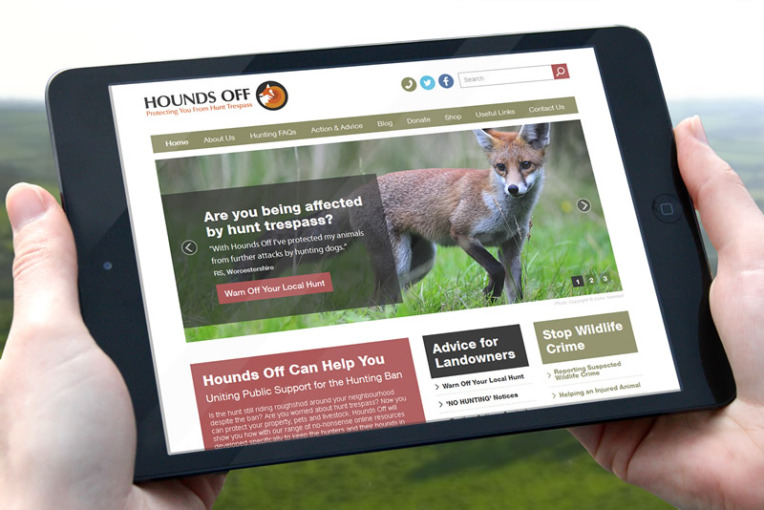
Hounds Off launch new website to protect farmers, landowners and the public against wildlife crime

Standard

hounds-off-ipad-cc-blog

Hounds Off, a free online resource designed to help landowners, farmers and residents to protect their property and pets from hunt trespass, and to encourage the public to report suspected wildlife crime, has just rebranded and launched a fantastic new, easy-to-use website.

The new logo was designed by Dorset Illustrator / Designer Stu Jones, who is the talent behind our own Dorset for Badger and Bovine Welfare logo and the Dorset Badger Vaccination Project’s logo, and is a key member of local animal welfare group Compassionate Dorset.

Hunting most wild mammals with dogs for sport was banned in England and Wales in 2004, including fox, deer, hare, mink and also badgers, yet many hunts are continuing illegally and often cause ‘hunt havoc’ in the countryside.

As Hounds Off say on their website; “Most compassionate, decent, fair-minded folk in Britain disapprove of animal cruelty. Latest opinion polls found that 76% of the British public are against fox hunting being legalised, rising to 81% for deer hunting and 83% for hare coursing.”

With the threat of the badger cull, we have also realised just how loved our British badgers are too, and they are of course otherwise a protected species. Check out some badgery facts on the new website at: www.houndsoff.co.uk/hunting-faqs/badgers-other-mammals.

There are also lots of gorgeous foxy clothing, prints, cards and accessories we are sure you will love, if you haven’t seen them already, on the  Hounds Off shop at: www.houndsoff.co.uk/shop (and we hear on the grapevine that car window stickers will be available very soon too!).

The new website has now had over 3,000 shares on Facebook alone in just 2 weeks of relaunching so please do share the site yourselves to spread the word of this valuable resource.

Read more at the new website at: www.houndsoff.co.uk/blog and view the website at www.houndsoff.co.uk.

Yet Another Debate on the English Badger Culls

Standard

And here is another great recent article by Lesley Docksey

“A change of protocol half way through an experiment reveals such a limited understanding of the scientific method that I am tempted to speculate that the government no longer wants to know whether the pilots are effective or humane. They just want to cull badgers, regardless of whether the population or humaneness consequences can be assessed.” Prof. Tim Coulson, member of the ex-Independent Expert Panel

The scientifically useless, inhumane and very unpopular government policy of killing badgers, supposedly to help eradicate bovine TB in cattle, is still being pushed by the Department for the Environment, Food and Rural Affairs (Defra), with the National Farmers Union stepping on their heels.

How many more debates will be argued in Parliament, and how many more letters signed by scientists, vets and wildlife experts will be sent to Defra, to the Environment Secretary, to the Prime Minister and the national press before the government finally yields to science and lets the badger cull go?

The second year of the culls ended with a bit of an embarrassing whimper. We can at least be grateful that Natural England was wise enough not to issue extended licences this year, but the leaked figures showed another failure. Before they even began the cull, the targets had already demonstrated that the process was a failure anyway. Had Defra pulled the figures out of a hat they wouldn’t have been any less realistic.

Defra’s only response to the leak was: “The figures still need to be independently audited. The humaneness of the culls will also be reviewed.” Given the extremely poor records provided to the AHVLA and the Independent Expert Panel by the contractors last year, I doubt the figures provided this year will be any more accurate.

As Defra got rid of the IEP, who are the ‘independent auditors’ they are proposing to use? Will the public ever know, let alone be able to judge their independence? Could it be NFU executives or a panel of grouse moor owners? A single auditor, perhaps? Certainly it would be difficult to get badger and wildlife experts to take part – they’ve mostly all migrated to the anti-cull camp. Nor is any date set for when Defra’s results will be made public.

Which is why there was yet another debate among Members of Parliament in the Westminster Hall on November 4, this time to assess the culls. Though there were fewer MPs present than in previous debates, those speaking against the culls have become much more informed on the issues. Sadly the pro-cull side is still using the same arguments and justifications, dealing with the reservoirs in wildlife and all the rest. They must really believe that if you repeat something often enough it will turn into the truth. A vain hope.

On the day of the debate the Journal of Animal Ecology offered to provide “a transparent and independent review of the available evidence”, a generous suggestion which was, of course, turned down by the Farming Minister George Eustice.

The debate was led by that stalwart badger defender Chris Williams. In his opening remarks he made his opinion clear:

“…on badger culls scientific, parliamentary and public opinion are at one, yet the Government are completely disregarding all those areas of clear opposition to their direction of travel on the issue… the Government and all of us present are elected by the British people and not by any single issue group. Ministers seem to be behaving as if they were the parliamentary wing of the National Farmers Union. The NFU, however, does not even represent the vast majority of the farming industry…”

Which greatly upset Neil Parrish, very much an NFU farmer from the West Country. Anne Main, who had led a previous badger cull debate, later responded to Bill Wiggin (Conservative, N. Herefordshire) , “I certainly shall give way to the branch of the NFU that is my hon. Friend.” Clearly the anti-cull MPs had identified the NFU’s influence on Defra as being a major part of the problem, and were giving it a good, if polite, kicking.

But the real heart of the debate was, and always is, that badgers are to blame for the spread of TB in cattle. We are asked to accept that vaccinating diseased badgers will not cure them of TB. Whoever, except pro-cull MPs, Ministers and the NFU, have ever suggested such a scientific silliness? And, however much they talk about the Welsh badger vaccination project, they will NOT talk about the real reasons behind the reduction of bTB in Wales.

As an example, Simon Hart (Conservative, Carmarthen West and South Pembrokeshire) said:

“The reality is that the Labour Government in Wales fully recognise that they cannot measure the impact of vaccination yet, and what reduction there is of bovine TB in Wales is just the same outside the vaccination area as it is inside…”

Might it be that that a policy covering the whole of Wales is working? But no. Back to the badgers. Geoffrey Clifton-Brown (Conservative, The Cotswolds) agreed.

“Although TB has been reduced in Wales, the current vaccination programme is only being conducted in 1% of the country and it is only in its second year. It is therefore difficult to see how the Welsh experiment – as he said, the Labour party in Wales do not think it is working – has led to a 25% reduction across the whole of Wales, where other factors must be at play.”

Actually, the Welsh government do not and have not ascribed the reduction in TB to badger vaccination. Other factors? Would they even look at them? Annual testing of cattle, strict movement controls, bio-security measures – oh no no! Don’t even go there. Anne McIntosh weighed in with how expensive badger vaccination is: “In Wales, the cost of an injectable vaccine for badgers was estimated at about £662 per badger in 2012.”

However in 2014, the first year of operating the Dorset Badger Vaccination Project, the cost was something over £300 per badger, and now that equipment such as cage traps have been bought, they are looking to halve that cost next year. All this has been done on donated funding. The farmers have not had to pay. But in Somerset and Gloucester farmers are funding the culls, on top of all their other financial problems. And the true costs of last year’s culling were leaked.   As the Badger Trust reported on November 14:

‘The front page of Daily Telegraph today says that each badger killed during last year’s cull cost £3000, with 1,879 badgers being killed at the cost of £6.3 million. However, a glaring omission from the figures is the £3.5m cost of policing the cull. When this is added on, the cost per badger is actually £5,200.’

But what would George Eustice have to say about Wales and its reduction in bTB?

“My hon. Friend Geoffrey Clifton-Brown and others highlighted the situation in Wales and the limitations of vaccination. He is right that it is wrong to read too many conclusions into the fall in incidences of the disease in Wales.”

Would he mention anything about Wales other than badger vaccination? Never. But as Farming Minister, he must have known what the latest bTB statistics were showing. Just two days later a notable list of 26 scientists and vets wrote to David Cameron, asking him to listen to science and abandon the culls.

“If we are to control bTB in England, as Wales is showing it is able to do, we consider that a fundamental change in emphasis and direction is needed. The time, effort and resources directed at the badger cull should be re-directed into:

  1. a TB Health Check for England to establish the true extent and distribution of the disease in our cattle herds;
  2. considerably more testing in the Low Risk Area with the implementation of nationwide annual testing and
  3. the introduction of mandatory pre-movement testing and risk-based trading across the whole country.

At the same time the livestock industry, NFU and farmers must be made aware that such cattle controls are essential if bTB control is to be achieved.”

And they kindly added an appendix that explained the latest statistics from Defra. For a pro-cull government, intent on keeping the NFU happy, they do not make comfortable reading. Nor do they support those NFU farmers who insist that bTB in the West is ‘out of control’.

(These figures are updated from the latest Defra statistics, released on November 12.)

In the West Region, which covers a far greater area than that covered by the Somerset and Gloucester culls, the number of cattle slaughtered due to bTB fell by 12% between 2012 and 2013, and the trend is continuing into this year; the 2014 January-to-August period showed a reduction of 14% compared to the same period last year.

In Wales there was a 15% reduction in new TB-affected herds and a 23% fall in cattle slaughtered during September 2013 – August 2014 compared to the same period a year before.

But in the East and North Regions, the cattle-slaughter rate increased by 10.2% and 9.09% respectively from 2012 to 2013, with the trend continuing to rise this year.

How can this be? It’s really very simple. The West Region has long been regarded as England’s bovine TB ‘hotspot”. As such, farmers have to put up with annual and pre-movement testing, as well as cattle movement restrictions with, initially, the greater levels of slaughter. Initially because, as infected cattle are found by increased testing and taken out of the herds, with each year fewer cattle can be infected. All of Wales has had such measures since 2009. In the East and North, however, there are many areas that have far less testing and cattle controls, and that opens the door to bTB.

Are you listening, Mr Cameron?

In the face of Defra’s own statistics, we don’t really need their ‘independent’ audit on this year’s culls. And surely we do not need any more debates, or letters to Ministers or emails to MPs. And we most certainly do not need any more senseless killing of the badgers. Farmers have to ask themselves – will they put up with the controls that result in healthy cattle or be put out of business by TB?

20/11/14 © Lesley Docksey

First published by Brian Mays’ Save Me www.save-me.org.uk

The English Badger Culls: the NFU’s Successful Failure

Standard

Here we share anther great article by Lesley Docksey...

The UK government’s highly unpopular ‘pilot’ badger culls have just come to the end of the second year of a four-year programme. Even without the independent oversight, monitoring and auditing by an Independent Expert Panel (IEP), discarded by the government after last year’s slating by the IEP, the culling has been as much of a failure as last year, despite the National Farmers Union (NFU) hailing it as a ‘success’.

But the NFU has been steering this policy of slaughtering our badgers for years. Ever since the first bovine TB-infected badger was found in 1971, to the surprise of animal scientists, farmers who dislike the controls and testing of cattle that can reduce the incidence of bTB have had something other than farming practices to blame.

Strict testing and bio-security controls were well on the way to eradicating bTB by the late 1960s, and complacency set in. A farming friend told me that he can remember farms with TB being required, among other things, to install double fencing between fields; he can also remember the very actions that had brought the disease under control becoming non-mandatory.

Once badgers came into the picture farmers started to cull them. To their annoyance in 1973 the badger was given some, but not enough, protected status. Even so, in 1975 ‘strategic culling operations’ were being carried out by gassing. This was banned in 1980 but the killing went on. Unfortunately, the incidence of TB in cattle was rising again.

No one mentioned the changes in farming practices; the intensification of cattle, particularly in dairy farming; the importing of continental breeds with no proven immunity to TB; increased cattle movements (another farming friend, trying to trace a bull calf they had sold, found it had moved 10 times in two years); and the fact that farming had become an ‘industry’.

Also, despite the fact that humans have been vaccinated against TB for 90 years (though the protection against being infected with TB is only about 70% effective), farmers are still waiting for a cattle version to be developed. It is always “10 years away”. In 2011 Brian Walters of the Farmers’ Union of Wales said:

“We were told 20 years ago a vaccine was 10 years away, now we’re being told it’s eight years away.”

Sorry Mr Walters, but two years later, in 2013, the EU Commission was telling Defra that a vaccine may not be commercially available until 2023, even though since 1994, the UK has spent some £43 million on developing one. And the field trials which the EU wants us to undertake have been delayed until next year. A very muddled picture with too many people giving too many reasons why we can’t vaccinate cattle yet.

The NFU, for commercial reasons, doesn’t like vaccination as a method of tackling serious disease in farm animals. It blocked the vaccination against foot and mouth disease in the disastrous 2001 outbreak. MP Eric Martlew, speaking in the parliamentary debate on FMD in April 2001, said “I believe that no matter what the Government say, they will not persuade the NFU to accept vaccination.”

Big farmers can’t successfully export vaccinated cattle. It would have cost them over £250 million a year in lost trade. But as a result of their veto millions of animals were slaughtered; farmers lost their herds, their livelihoods and their lives through suicide. It cost the country billions. Even worse, TB testing was dropped during the outbreak and afterwards farms were restocked with untested cattle. The incidence of bovine TB rocketed. Would that have happened if the NFU had allowed vaccination?

And of course, they blamed the badgers and the NFU lobbied for a cull.

In 2005 the Department of Environment, Food & Rural Affairs (Defra) produced a consultation report on badger culling. In its introductory paragraph it says:

“The Government has decided further measures should be implemented now to reduce cattle to cattle spread. But international experience indicates it is not possible to contain and eradicate bovine TB if its background presence in wildlife is left unaddressed.”

Both Defra and the NFU have been selling the ‘international’ line unremittingly. Killing wildlife comes before any other option. The RSPCA picked the whole of Defra’s report to pieces:

“The RSPCA is… concerned that there is a lack of balance in the document. Shortly after its publication the Independent Scientific Group (ISG) stated in an open letter to stakeholders that the paper was inaccurate in important aspects.   The advice of the Science Advisory Council (SAC) – set up by Defra to provide expert, independent and published advice on science policy and strategy – is ignored. Additionally, very selective and misleading use is made of scientific material. The end result is one that appears to be designed to advance a cause rather than a balanced document and… calls into question Defra’s commitment to evidence-based policy making.”

In addition, why had Defra chosen to ‘consult’ with so few bodies (with some emphasis on agri-business) while ignoring major environmental and wildlife organisations like itself?   For each of the questions posed by Defra, the RSPCA has negative responses. And then the NFU raises its head again:

“The RSPCA is concerned… that a decision about a badger killing policy may be introduced because of “the need to win co-operation with farmers on introducing movement testing and compensation, and the wider objective of industry, over time, bearing a progressively greater share of the costs of bTB controls.” This could imply that badger killing might be introduced as a sort of quid pro quo in relation to the farming industry rather than on grounds of the wider issues of sustainability and scientific evidence. This concern is reinforced by the policy decision by the NFU not to co-operate with Defra on pre-movement testing until the government announces a cull of badgers and the recent Defra announcement to delay the introduction of such testing.”(my emphasis)

Reporting to the Parliamentary Committee for Environment, Food and Rural Affairs, Professor John Bourne, head of the ISG, said:

“You ask how the scientific information has been handled by the media and by Defra and I’m bound to say I don’t think it’s been handled terribly well…I was obliged to write to Ministers complaining that the scientific information presented in the exercise was inaccurate and also stating that two of their proposed culling proposals would in fact make the situation worse (Author’s note: the RSPCA also rubbished the third culling proposal). I’m sad to say, yes, I don’t think they [Defra] have done a very good job of it and one of our comments in the final report is that Defra do seem to be unable to handle scientific data and translate that in to policy… it would be really helpful if Defra embraced the science and stimulated discussions with the NFU based on the science to develop science-based policies”.

The NFU did not get its badger cull. In 2008 the Environment Minister Hilary Benn told Parliament:

“Having listened carefully to a wide range of views from scientists, farming, veterinary and wildlife organisations, and many others, and having considered all the evidence, I have decided that while such a cull might work, it might also not work. It could end up making the disease worse if it was not sustained over time or delivered effectively, and public opposition, including the unwillingness of some landowners to take part, would render this more difficult.

“I do not think it would be right to take this risk. Therefore – and in line with the advice I have received from the Independent Scientific Group – our policy will be not to issue any licences to farmers to cull badgers for TB control, although we remain open to the possibility of revisiting this policy under exceptional circumstances, or if new scientific evidence were to become available.”

Instead, the government put in place 6 badger vaccination schemes along with pre-movement testing and cattle control regimes. But the NFU didn’t give up. They threatened a judicial review and other legal actions over Benn’s ban on badger culling saying, “we remain committed to supporting a challenge to what we believe is an unlawful restriction on producers’ ability to take action to prevent the spread of TB on their farms.”

I like the word ‘producers’. This is about big business, not small struggling farms.  And note, they also, in partnership with the pro-hunting group Countryside Alliance, made a deal with the Tories: give us the badger cull and we will give you the rural vote in the 2010 general election.

In 2009 Wales took the decision not to cull its badgers but instead to put in place annual testing for cattle and strict bio-security and movement controls – with the result that they have cut their incidence of bTB by 50%, something the Welsh branch of the NFU tries to deny.

Following the election in 2010 almost the first thing the Tory-led coalition government did was to cancel 5 of the 6 areas for badger vaccination trials and start planning to kill badgers, despite the lack of any new scientific evidence that culling was the answer. The guns would have preferred to get out and start shooting straight away, but culls take time to organise, particularly if the public are going to object. Defra and Natural England, which would be issuing the licences, had to tread with care.

While Defra did its best to make the whole exercise look scientific, with monitoring and setting up the Independent Expert Panel to audit the results, the NFU set up a culling company for each area where the killing would take place. There was much talk of ‘good marksmen’ etc.  Unfortunately, men with guns do not necessarily equate with fieldcraft and accurate knowledge of badger numbers.

Culling was supposed to start in 2012 but had to be postponed. There were too many badgers, too much rain, not enough policemen and farmers couldn’t be confident of being ready in time.   There were more arguments over badger numbers the following year, ending up with the culling period being extended because the guns couldn’t kill enough, prompting the now-famous quote from the Environment Secretary Owen Paterson: “the badgers have moved the goalposts.”

And all this while, the NFU, aided by Paterson, kept repeating that all badgers in TB ‘hot spots’ had TB, all TB in cattle was down to badgers, and that the only way to halt TB in cattle was to kill the badgers. Oh yes, and bovine TB is the greatest threat to farming, out of control and getting worse each year, this despite Defra figures showing that, little by little, TB was decreasing. It was really not the problem it was hyped up to be.

It was not surprising that, with no other advice from the NFU and Defra, most farmers were persuaded to support the culling and hate the people protesting against it. And while it truly is devastating for a farmer to see his herd succumb to TB, the NFU never mentions the larger-by-far number of cattle slaughtered because of lameness or mastitis. And Defra has stopped recording those figures.   Do they not want to tackle the issue of poor husbandry?

When the culls finally started in 2013, the then NFU President Peter Kendal said:

“I am confident however that through the combined efforts of farmers, the NFU and government over the last year to illustrate the impact TB has on farms, and the scientific basis for badger control, more people than ever recognise the need to address the disease in badgers.”

But the public weren’t swayed by the ‘scientific basis’ then, and even less so now. Almost 90% of people are against any more culling. And they were right. Last year’s culls failed on numbers and humaneness and also, I think, on safety. So what does Defra do? It lowers the number of badgers to be killed this year but gives huge margins, between 316 and 1,776 for Somerset, and between 391 to 1,292 for Gloucester, figures that were dismissed as ‘rubbish’ by many experts. To be on the safe side Somerset’s target was 316 and Gloucester’s 615 And just to be sure of ‘success’ it gets rid of any independent oversight and auditing.

It didn’t work. On the day the culls ended up pops Andrew Guest of the NFU with this statement:

“I think generally we are pretty pleased with how it has gone. In large parts of the area we are seeing very few badgers left on the ground now. Unfortunately there are one or two areas where we haven’t been able to be as effective as we’d like to because of the actions of protesters but largely we are very happy with it.”

In Devon, Dorset and Cornwall they had been busy planning for badger culling next year. The NFU wants to make the culling areas bigger so that there aren’t enough anti-cull people to get in the way. Everyone was gung-ho for more killing.

Unfortunately, the Guardian published figures leaked to Team Badger by someone working for Natural England – in Somerset they managed to kill 315 badgers and in Gloucester the total killed was 253. Defra has neither confirmed nor denied the leaked figures. Unlike last year, no extension has been allowed ‘for political reasons’.

The word is that, with two failures in two years, the culls will not be rolled out to other areas; and the current Environment Secretary Liz Truss, who has been very silent about the culls, has reportedly been told to abandon the culls until after next year’s election. The Labour Party has already committed to scrapping the culls if it comes into power. Politicians have to take account of the fact that the hated badger cull is among the top 5 issues that constituents contact their MPs about.

That all went well then.   The NFU blamed the protestors.  Some of the guns had blamed really good weather with bright moonlit nights when they couldn’t use their infra-red sights. I’m surprised they didn’t blame the badgers. It really is time someone put the NFU out to grass. Both farmers and wildlife deserve better.

And if you haven’t quite got the message – Defra has its headquarters in Smith Square, London. The NFU’s London headquarters are in… Smith Square, London.

24/10/14 © Lesley Docksey

Badgers at Dawn

Standard

Anyone who volunteers for Dorset for Badger and Bovine Welfare will know we are an extremely active bunch, which means we’ve not always had time to keep our blog as up to date as we would like! So to kickstart 2015, we thought we would share some great recent articles by Lesley Docksey so here is the first. Look out for more Dorset badger news soon too…

While people are fighting to protect the badgers from the UK government’s infamous culls, they are also working to protect the badgers from bovine TB by vaccinating them. The season for vaccinating badgers against bovine TB has finished for this year, and for those people wanting to help protect badgers from disease, it is time to think about volunteering for next year’s vaccinating. What does this involve?

All is quiet in the wood. Light is slowly seeping through the leaves but it will be some time yet before sunrise. Barely enough light to see when I have to duck to avoid a branch, or where to place my feet among the fallen trees and undergrowth. The others move ahead, voices hushed as they search among the trees. I pause and listen to the silence of an old wood broken by a wood pigeon waking up. Moments later there is a soft ‘caw’ from a crow. Soon the trees will be full of chatter but right now each single murmured call only deepens the silence of the wood waking to a new day.

I was here a few days before, in the early evening, watching cage-traps being baited, part of the process of badger vaccination. There was enough light then to appreciate the trees, new, old and the fallen dead, to stop and touch, take out my camera to capture the vine-like stems of Travellers’ Joy climbing up the trunks of the beech, sycamore, oak and ash; enough light to see the sett, the excavated soil, the entrances with their well-trodden earth, and the badger runs through the grass, out of the wood to another sett, beside a small lake hiding among more trees.

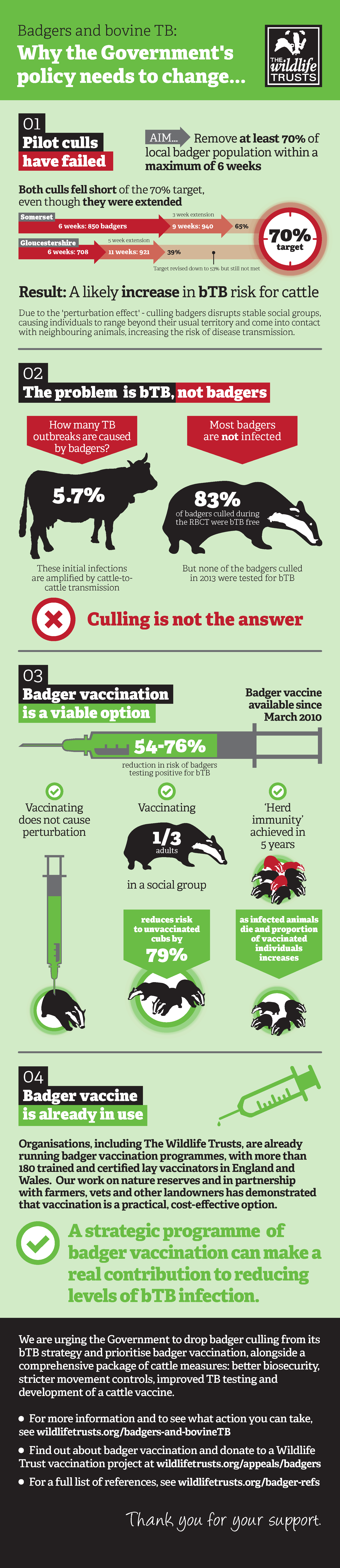
This must be one of the best rewards for all the hard work that goes into vaccinating badgers – being able to visit parts of the countryside that would be off-limits to Joe Public, and believe me, it is hard work. But vaccinating badgers against bovine TB has two benefits. Vaccinated and disease-free badgers are no threat to cattle and in return, cattle cannot infect the badgers.

Vaccination can only be done at the invitation of the landowners. And confidentiality is an absolute must. Many farmers actually like their badgers but, while they want to protect them they are still wary of the often nasty (and violent) backlash from those who blame badgers for all their ills. Now that Defra is visibly backing badger vaccination it may become easier for them to go public – in time.

So what has to be done before a badger can be vaccinated?

First catch your badger. In preparation, surveying each sett and its surroundings must be done, noting where the badgers’ runs are, where best to place the cage-traps. Each place is then baited with a handful of peanuts – a badger favourite – to encourage them to visit the sites where the cages will be.

Then the hard work begins. The cages are large and heavy. They have to be, to cope with animals that are stoutly built and strong. The cages cannot just be placed on the ground. Their bases must be dug in to prevent a captured badger overturning them. Digging them in may be fairly easy in some locations but badgers do prefer woods, banks and hedgerows, places with lots of roots and difficult digging for the team. Each sett will have 5 or more cages dotted around the badgers’ territory.

In place, every cage is left open with some peanuts at the far end, covered with a large flat stone. Rodents and foxes won’t move the stone. Badgers will. Early each evening the team will freshly bait all the cages. Over several nights badgers learn to enter the cage, push aside the stone and eat the peanuts.

Then the cage becomes the trap. The stone is wired to the catch that keeps the door to the cage open. The badger goes in, pushes aside the stone, the catch is released and the door comes down, trapping the badger. Ah well, at least it can eat peanuts while it waits for dawn and vaccination.

Vaccinating the badger

All vaccination has to be done by trained and licensed vaccinators, but helpers are still needed, which means people happy to get up very early so that the badgers can be released before full daylight. Put simply, each trapped badger is vaccinated, has some hair cut off its back and that area sprayed with coloured paint. As the trapping continues for several nights, this identifies the badgers that have already been done, a necessary thing as I discovered on the first occasion I hoped to witness a vaccination. All the caught badgers had already been vaccinated, and trapped themselves again for the sake of more peanuts.

Badgers are individual in their reactions. Some are angry or frightened at being trapped, and will spend the night trying to dig themselves out, resulting in more earth inside the cage than out, and a very dirty badger. Others pull grass and other plants into the cage, make a bed and go to sleep – and have to be woken up for their vaccination. Some are very feisty and do their best to avoid the needle. And some are very laid back indeed.

Some badgers have to be encouraged to leave the cage they’ve spent the night in, and I was told of one that was so fast asleep it was vaccinated, hair cut, paint-sprayed and the cage opened, and still it slept. A certain amount of prodding was needed to wake it up and make it leave the cage and scuttle back to the sett.

And the hard work doesn’t stop there. The cages have to be taken away, cleaned and disinfected before being replaced and re-baited. The cages are big, and much heavier at one end than the other. This makes them awkward to carry and the heavy-duty wire they’re made of can cut into your hands. Small hands need heavy gloves to protect the fingers!

Training to be a vaccinator

Having said all that, there is now an army of people all across England who are volunteering to do the work and even to put up their own money in order to train as a vaccinator.   The training course lasts for 4 days (this will possibly be extended to 5) and is run by the Animal Health & Veterinary Laboratories Agency (AHVLA) in Gloucestershire. The full cost is £750. If one is a member of a recognised group Defra fund half the fee. The vaccinator’s licence from Natural England costs £350 a year but once again Defra will pay half if the candidate is part of a group.

It’s not cheap, training to protect badgers, but someone who had done the course said, “The course is excellent and everyone in our group enjoyed it. I believe the proposed extra day is to add a bit more badger ecology.”

But people trying to book up for next year’s training are worried. One of Dorset’s vaccinators said, “As far as we know, the training course for vaccinators that we have all been doing for the last two years has been cancelled. The last course finished at the end of September. No one can book in for next year. We think there may be a replacement, but we haven’t heard.”

“So the only training courses are held by the AHVLA, the course has been cancelled, no one can book up to be trained, Defra is now backing vaccination and no replacement course is in place?” This was Puzzled from Dorset asking for clarification.

“Yes, you’re right. They’re backing it and they’ve cancelled the courses. I don’t understand why. Maybe they’re going to introduce a better one…”

The AHVLA spokesman said, “It is right to say that the course has been cancelled but that will be replaced by Defra as part of the Badger Edge Vaccination Scheme. It is intended to support larger scale vaccination.”

Was there any possibility that there would be regional centres for training? “At the moment I don’t think that has been discussed.” He appreciated that volunteer vaccinators put up quite a bit of their own money to pay for training; being able to travel to a centre perhaps within their own county would greatly reduce the costs of travel and accommodation.

“Defra will be announcing the new scheme later this year, possibly in November, and I imagine details like that will be included, particularly as the Edge vaccination will be covering much larger areas.”

Whether the actual training will be enhanced is not yet known. Nor did the AHVLA spokesman seem to know. Like everyone else, he was waiting on Defra. What is clear is that, while Defra are happy to help fund the training of more vaccinators, they will now only do it for those working in the ‘edge’ areas – Berkshire, Buckinghamshire, Hampshire, Leicestershire, Northamptonshire and Nottinghamshire and parts of Cheshire, Derbyshire, East Sussex, Oxfordshire and Warwickshire.

People living anywhere else and wanting to help protect their badgers from this awful disease had better start fundraising! And they will. The badger culls have helped people to discover just how important their wildlife is to them.

But you can expect those who support the culling of badgers to say that vaccination is useless and won’t help. There is a deliberate muddling of ‘science’ in the hope it will make those arguing for the vaccination route look really stupid. It was used by Owen Paterson when speaking to Parliament in April this year:

“Sadly, injecting diseased badgers in the hot-spot areas with cattle vaccine will not reduce the incidence of the disease.”

Very recently the director of the Farmers’ Union of Wales said we don’t appear to understand that vaccinating diseased farm animals wouldn’t make them healthy. None of us have ever made such a silly claim. The majority of badgers (and cattle) are free of TB and we want them to stay that way by vaccinating them. An increasing number of farmers agree with us.

08/10/14 © Lesley Docksey

It’s About to Begin Again – Time To Get Into The Field and Stop The Slaughter

Standard

A badgerOne year on and it’s time to get back into the field to stop the culls in Somerset and Gloucestershire. Since Somerset is closest to Dorset, we will be focusing our support there. Last year car-loads of supporters from Dorset were out in the zone, and this year we want to make sure even more people are involved.

For those wanting to walk the footpaths then the Somerset Badger Patrol is for you. You can follow them and get updates on Facebook or via their website. They meet at a central location every night and walk on public rights of way in large visible groups throughout the cull zone. 

Dorset Hunt Sabs will also be in the zone every night and need as many people in the field as possible. The simple fact is that if people are in the immediate vicinity of shooters, then the shooters MUST pack up and move on. This is truly lifesaving work, so if you feel you are able to help please contact them. They will have experienced people who know the area leading small covert groups. They also have much of the equipment needed but are in need of support to get one essential bit of kit – a thermal imager, which you can help fund here.

Although Dorset has been spared the cull for now, we cannot let our guard down, a cull could be sprung on us at any time, since all the formalities have already been done and the NFU propaganda machine is working in overdrive pushing for a cull in Dorset. One of the things that will make a cull less likely is to have a strong vaccination programme running in the county, which is why we strongly support the Dorset Badger Vaccination Project, who are doing incredible work. Please support them so that in the coming months they can make sure more of Dorset’s badgers are protected from bTB and the cull.

However you can help, now is the time to get active and involved. Please show your support and let’s make sure this year’s culls are even more pointless than last and that we put an end to this whole sorry mess once and for all.

Badger Groups in South West Join Forces, Pledge to Stop The Cull

Standard

ex1

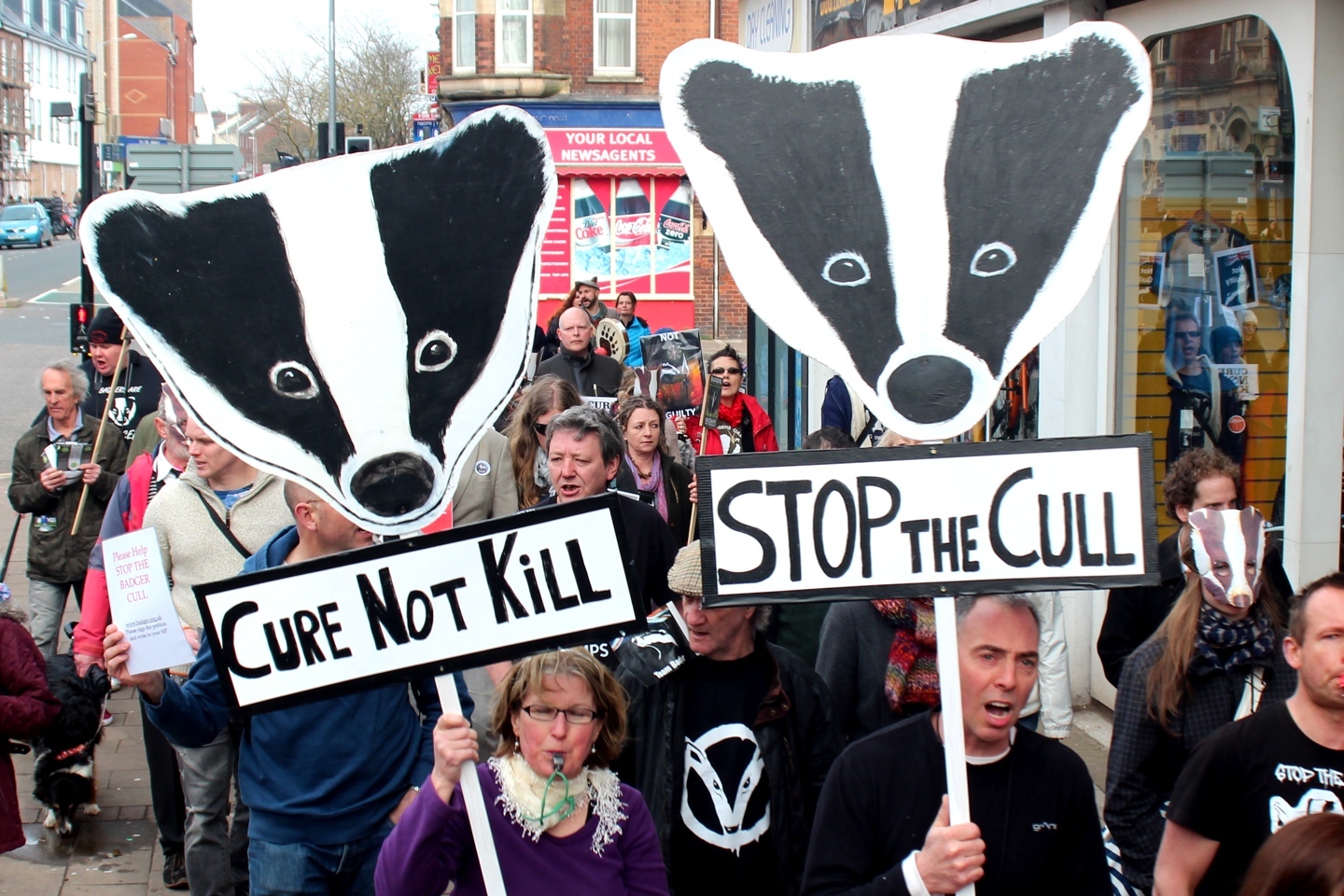
Grassroots groups working on the ground to stop the badger cull have joined forces under the South West Alliance for Badgers (SWAB). Sharing skills, resources and information the alliance formed after news that the unscientific, inhumane and ineffective culls from last year will be continued in Somerset and Gloucestershire. News that Dorset will be spared for now is a huge relief for the county and Dorset campaigners have pledged their full support to groups in the cull zones.

A statement released today by South West Alliance for Badgers reads:

The evidence is in and couldn’t be clearer; killing badgers as a means to tackle bovine TB is ineffective and inhumane, yet the government is ignoring the science, the will of the public and that of parliament. It is clearly working to a political agenda rather than a practical or scientific one.

The cull has not only failed to provide the results claimed for it but has proved hugely more expensive to taxpayers and farmers than vaccinating badgers and potentially other alternative methods of controlling bTB in cattle. It has also caused huge divisions within the community and imposed enormous costs and operational problems for the police.

The government has consistently misrepresented the facts and the need for culling, concealing the information that UK herd infections were already decreasing prior to the pilot culls due to improved testing and cattle controls alone. Badgers have been virtually eradicated in some areas of the Republic of Ireland but this has proved no more effective in reducing cattle infections than in Northern Ireland where no badgers have been killed. However, results from Wales, where the new cattle controls have been combined with badger vaccination, have proved that this is by far the fastest, most effective and humane method of controlling bTB in cattle.

As groups concerned with animal welfare and wildlife conservation in the South West we cannot sit by and allow this pointless slaughter to continue. As with the ‘pilot’ culls last year, we will be back in the field saving as many badgers lives as we can, and we will be doing so with increased numbers, and increased determination.

In the meantime we will continue to support the many local and national badger vaccination schemes giving farmers, land-owners and councils a clear choice: either opt for unpopular, unscientific and ineffective killing, or choose a humane, scientifically proven, effective and cheaper route: vaccination of badgers.

This statement will be released by each of the member groups of SWAB and communicated to their members and is the first step in greater cooperation between the frontline grassroots groups in the South West.

South West Alliance for Badgers (SWAB) currently consists of:

Dorset for Badger and Bovine Welfare

Gloucestershire Against Badger Shooting

Somerset Against the Cull

National Union of Farmers say “You’d Be A Fool To Cull Badgers”

Standard

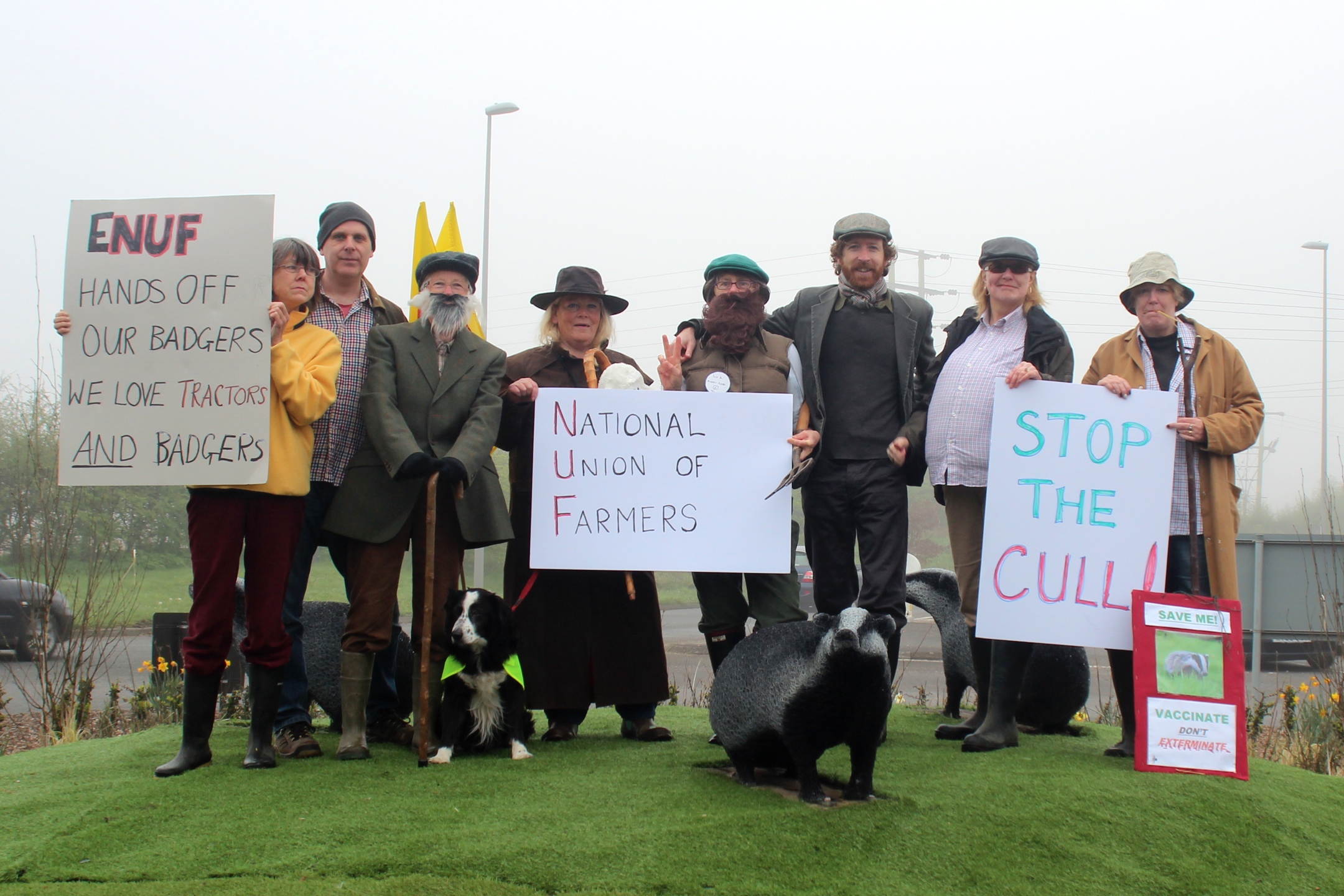
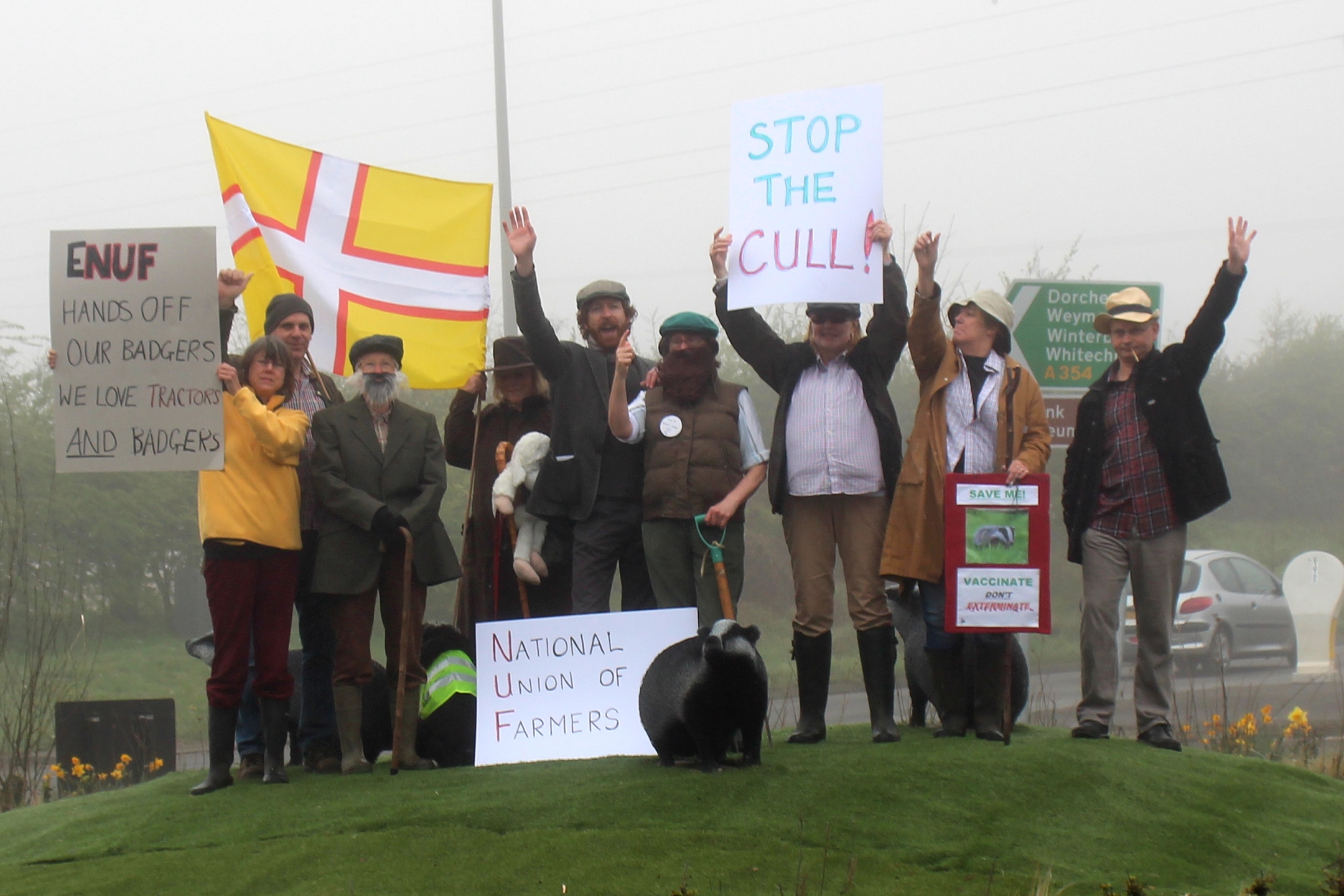
NUF

Members of the Dorset branch of the National Union of Farmers (NUF) today protested against the proposed cull of badgers in the county by taking over the Badger Roundabout on the Blandford bypass. The farmers say they want to live up to their image as guardians of the countryside by abandoning their “if it moves, kill it” attitude and embracing a policy of encouraging biodiversity and protecting wildlife instead.
NUF Chairman Earnest Countryman said:
For years we’ve been saying that we care about animals, but in truth all we’ve really cared about is our profits. Now we’ve decided to take responsibility and action. Instead of blaming Bovine TB on badgers and pet cats, we want to get rid of the disease through better farming practices, improved biosecurity and stricter cattle movement controls. We will also be encouraging our members to accept offers of free vaccination of badgers, instead of shooting or poisoning them and dumping their bodies on the side of the road.
The National Union of Farmers primarily represents the interests of large-scale farmers, pheasant shoots and wealthy landowners and plays an important role in influencing government policy to ensure more money goes to big agribusiness and less to small and new entrants to farming.
NUF 1

Leaked Report Declares Badger Cull Ineffective and Inhumane

Standard

the newsFollowing a leaked report from the Independent Panel of Experts (IEP) showing that trial badger culls in Gloucestershire and Somerset had been an abject failure, we are calling for the culls to be abandoned and released this statement:

It was clear months ago that the culls were failing to reach key targets set by the Coalition Government, despite repeated denials by the Environment Secretary Owen Paterson, DEFRA and the NFU. Now the Independent Panel of Experts set up by the Government to review the results of the culls have confirmed everything we have been saying.

The IEP concluded that the culls  fell far short of the target numbers of badgers killed, even after extending both culls beyond six weeks, yet Owen Paterson had hailed them as a success. Many leading scientists and wildlife experts believe the failure of the culls could actually worsen the spread of TB. The Panel also found that the culls were not humane. Owen Paterson, without waiting for the Panel to report, claimed months ago that they were. According to Natural England Compliance Monitors some badgers took five minutes or more to die in agony after being shot.

The scientific facts were manipulated to suit the policy. DEFRA has also now admitted that both badger populations and TB rates in cattle were grossly overstated. Badger numbers were falling, not ‘soaring out of control’, which is what the Environment Secretary claimed. The three rotten planks shoring up this ramshackle policy have therefore collapsed.

The cull policy has been shot full of more holes than the unfortunate badgers who needlessly died. It is clearly time to abandon this unjustified and unpopular slaughter and implement other measures which have been found effective elsewhere, such as in Wales where a programme of badger vaccination, tighter bio-security on farms and cattle movements has produced a far more positive result for farmers than the two culls in England did.

In Dorset farmers and land owners have a clear choice, either pay for costly, ineffective and enormously unpopular mass slaughter of badgers, or opt for much cheaper, scientifically proven and humane vaccination of badgers through the Dorset Badger Vaccination Project.